
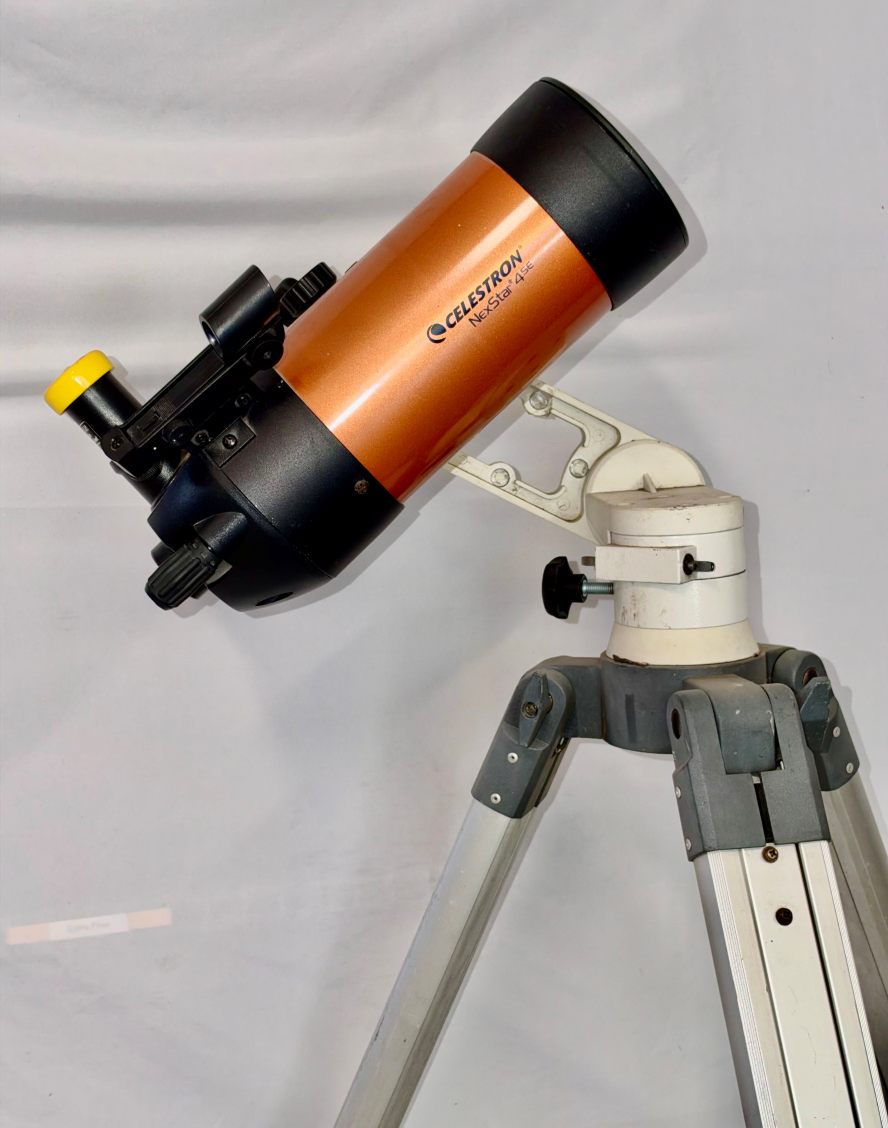
Celestron NexStar 4-inch Maksutov-Cassegrain Telescope on an Alt-Az Mount and Tripod
$100.00
1 in stock
This Celestron NexStar 4SE MCT includes a red-dot finder, a 25 mm eyepiece, plus a manual Alt-Az mount and tripod. It’s a great grab-and-go telescope for the Moon and planets.
Note: This optical tube is from Celestron’s SE line of Go-To scopes, but it doesn’t include an original computerized mount.
- Optical Design: Maksutov-Cassegrain
- Aperture: 102 mm (4.02 inches)
- Focal Length: 1325 mm (52 inches)
- Focal Ratio: f/13
- BK7 optical glass primary mirror
- StarBright XLT optical coating
- Multilayer aluminum/SiO2 (quartz)/TiO2 (titanium dioxide) mirror coatings with flat reflectivity across the light spectrum for both astrophotography/astroimaging and visual observation
- Multilayer MgF2 (magnesium fluoride) and HfO2 (hafnium dioxide) anti-reflective lens coatings
- High-transmission water white glass corrector lens with 97.4% light transmission
- Resolution: Rayleigh: 1.36 arcsec / Dawes: 1.14 arcsec
- Secondary mirror obstruction: 1.25 inches, 34.4% by diameter, 11% by area
- Internal 90° flip mirror: With the mirror flipped up, the 90° angle puts the head in a comfortable viewing position when the scope is pointed at or near the zenith; lay the mirror down to direct light to the visual back for astrophotography/imaging
Celestron’s NexStar 4SE 102 mm f/13 Maksutov-Cassegrain is a versatile, user-friendly catadioptric scope for observing everything from the Moon and planets to bright deep-sky objects like stars, galaxies, and nebulae. Celestron’s proprietary StarBright XL multicoating system increases light transmission throughout the optical path with anti-reflection multicoated lenses, highly reflective multicoated mirrors, and crown optical glass elements. Similar to their Schmidt cousins, the Maksutov design replaces the conventional front corrector plate with a convex meniscus lens, yielding a smaller secondary mirror that reduces obstruction and increases contrast while eliminating the need for periodic collimation.